Telephony: “The Great Telephone & Computer Convergence”.
Since the early 1980’s, consumer computers and other electronics have been converging with telephone computers and networks. In the late 1990’s, the first “Great Convergence” began. It was really two separate stories unfolding.
By the late 1980’s, the popularity of personal computing had grown immense. People everywhere, who were already utilizing their “Personal Computers” for many tasks, began to connect to other computers, via the telephone. A “Modem” (Modulator/De-modulator) would connect their telephones with other computers and information services. Like CompuServe and AOL (America On Line). Through these services, people began trading “E-Mail”, Legal Databases, packed with case information was being sold by the minute, etc.. These were extremely insecure, but worked well.
Meanwhile (early 1990’s), in the world of Telephones, whilst people were connecting their PC’s, along came affordable “Mobile Cellular Phones”. Since the early 1970’s, cellular phone bills were hundreds of dollars a month. While the big phone companies put up towers to compete, independent cell phone companies popped up around the country leasing out those towers. The marketplace grew, so it became cheaper and easier for everyday people to afford them. Amazing as it was, within just a few years, many people were cutting their phone wires and only using mobile phones.
Meanwhile, in the early 1990’s, the growth of CompuServe, AOL (and the commerce services within) drove the idea for an “Information Superhighway”. Late in 1995, what we know as the internet, was born. Because of the potential marketplace (which became bigger than gas & oil), Demand for high bandwidth (fast internet connection) was another new road of technology set for the great convergence. Now it was just a matter of time before the first “Smart Phone” appeared in the marketplace. The first of many platform smart phone systems was brought to the market in 1999 was called “Blackberry”. This unique product was developed by a company from Canada called “Research In Motion”. The amazing growth of Blackberry showed that the world was ready. People loved the idea that you can get email anywhere there was a phone connection.
Eight years later, Apple re-created their very successful iPod music player into a working Cell Phone. Creating more than just a cell phone with smart apps like email, there could actually be a marketplace for low cost, application specific programs. The first real successful app was a sophomoric program called “iFart”. This childish “Prank” like software app made $10000.00 a day for the original developer, “John Comm”.
Silicon Interposed Analog & Digital Microchips – The Next Great Convergence
Throughout all these years of telephone and computer convergence, the microchip has not converged. The worlds of Analog & Digital silicon design (and manufacturing) are amazingly different.
Over many decades, digital technologies became faster utilizing smaller transistors. The smaller transistors became, the faster they could run. Smaller sized feature also allows for more transistors in the same area, thereby producing a faster digital product that had more features. Over the past decade, finFET technology has pushed digital technologies into creating astounding products. It also forced digital into a highly restrictive design process which was even more un-welcoming for Analog circuits.
Along the same lines, with emerging high performance Analog technologies (and product development), Analog circuits became harder to develop and use on digital silicon platforms. Analog products require matching , isolation and critical node protections. These requirements are often met using epitaxial growth on wafers (for intense isolation) and many other non-digital processing steps.
Therefore, for over half a century, product designs’ end result is a large PCB with microchip components scattered. This was very troublesome since simulations for microchips typically have fixed models for what signals the PCB will provide. Inconsistencies in PCB manufacturing also led to huge failure analysis problems.

The convergence of Digital and Analog microchips is possible through Interposer Packaging. Today, there are entire design departments dedicated to just that.
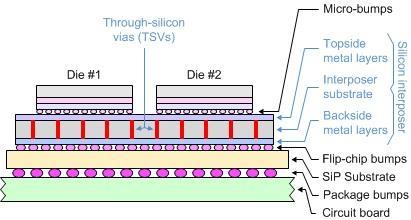
What are some of the biggest challenges for an interposer design team? To start with, we need to acknowledge Analog and Digital engineering literally requires two different thought processes. So the biggest challenge is translations. Translations of pad arrays from not only different designs, but separate tools and data formats. Layers for pad arrays, via’s, through substrate via’s (TSV) and wires. It still seems like a long time will pass before simulations can work through these complex interposed products. However, as computing power grows, along with application features such as multi-core enhanced verification and simulation, the possibility of simulating the whole product grows. With that comes more assurances for first time pass success.
In conclusion, it can be said that this next great convergence, which is already taking place has truly benefited our lives in both cases. Convergence of the telephone and computer was just as important as the Silicon Imposer microchip. One might wonder … what will the next great convergence look like?

 Simon IC Layout Design Services